

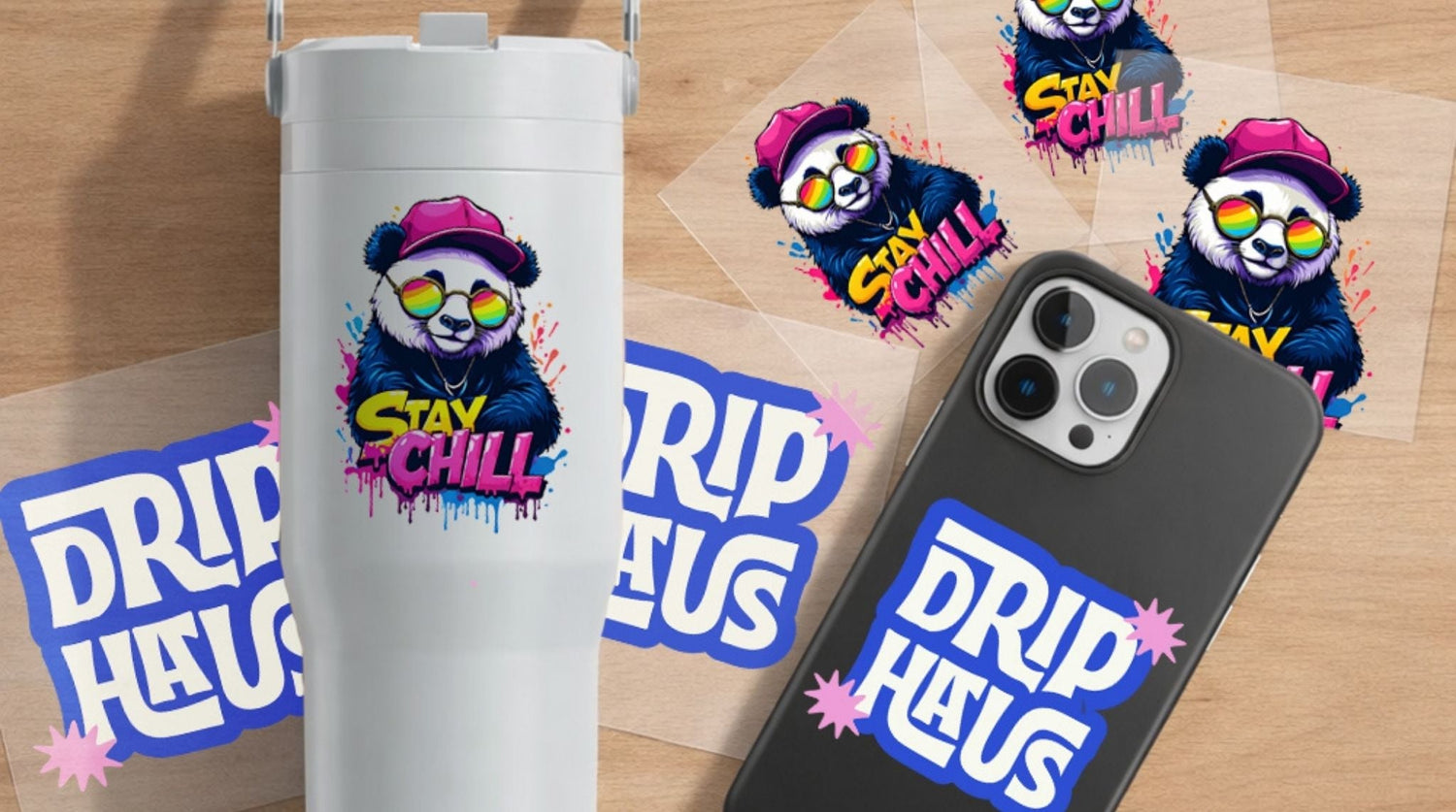
If you've been anywhere near the custom printing industry lately, you've probably noticed everyone talking about UV DTF transfers. This isn't just another printing fad - it's a technology that's fundamentally changing how we think about product customization.
While traditional DTF printing revolutionized fabric decoration, UV DTF has opened up an entirely new world of possibilities for hard surface applications. But what exactly makes this technology so compelling, and why is it generating so much buzz?
Demystifying UV DTF: What It Actually Is
UV DTF (Ultraviolet Direct-to-Film) represents a breakthrough in transfer printing technology. Unlike conventional printing methods that rely on heat or air drying, UV DTF uses ultraviolet light to instantly cure specially formulated inks, creating durable, professional-quality transfers.
The process works through a sophisticated multi-step system:
- Printing: A UV DTF printer deposits layers of CMYK ink, white ink, and protective varnish onto "Film A"
- UV Curing: As each ink layer is applied, UV lights immediately cure it, hardening the ink in milliseconds
- Lamination: "Film B" (the carrier film) is applied over the printed design
- Application: The finished transfer becomes a peel-and-stick decal that bonds to hard surfaces
This creates a slightly raised, glossy finish that looks and feels like it was printed directly onto the target surface.
UV DTF vs Traditional DTF: Understanding the Key Differences
The confusion between UV DTF and traditional DTF is understandable - they share similar names but serve completely different markets:
Target Surfaces
- Traditional DTF: Porous fabrics like cotton, polyester, and fabric blends
- UV DTF: Non-porous hard surfaces including glass, metal, plastic, and wood
Application Method
- Traditional DTF: Requires heat press, specific temperature, pressure, and timing
- UV DTF: Simple peel-and-stick application with pressure activation
Final Appearance
- Traditional DTF: Thin, flexible finish that integrates with fabric texture
- UV DTF: Slightly raised, glossy finish with premium tactile feel
Equipment Needs
- Traditional DTF: DTF printer, powder shaker, curing oven, heat press
- UV DTF: UV DTF printer, laminator for production; just application tools for use
Think of it as the difference between "fabric decoration" and "hard goods branding."
Why UV DTF Is Exploding in Popularity
Unprecedented Versatility
UV DTF has eliminated many traditional barriers to customization:
Complex Shapes: Curved bottles, irregular surfaces, and intricate items that were previously impossible to customize affordably
Material Compatibility: Works on glass, metal, ceramic, wood, plastic, acrylic - virtually any clean, hard surface
Design Complexity: Full-color gradients, fine details, photographs, and intricate text that vinyl cutting cannot achieve
Professional Results Without Industrial Investment
Previously, decorating hard goods with professional quality required:
- Expensive screen printing setups
- Large minimum orders
- Complex pad printing equipment
- Professional-grade direct printing systems
UV DTF democratizes this capability, allowing small businesses to achieve industrial-quality results with manageable investment.
Market Timing and Demand
Several factors have converged to create perfect conditions for UV DTF adoption:
Personalization Trend: Consumers increasingly want unique, customized products E-commerce Growth: Online sellers need cost-effective ways to offer customization Small Business Support: Entrepreneurs seek low-barrier entry into profitable markets Quality Expectations: Customers expect professional appearance even from small operations
Applications Driving UV DTF Adoption
Consumer Products
- Drinkware: Tumblers, wine glasses, water bottles, coffee mugs
- Tech Accessories: Phone cases, laptop skins, tablet covers
- Home Decor: Picture frames, decorative tiles, wooden signs
- Personal Items: Keychains, jewelry boxes, cosmetic containers
Business Applications
- Branding: Company logos on equipment, promotional items, packaging
- Signage: Office directories, equipment labels, safety signs
- Retail: Product labeling, point-of-sale displays, branded merchandise
- Events: Awards, commemorative items, conference materials
Craft and Hobby Market
- Personalized Gifts: Custom designs on everyday items
- Seasonal Items: Holiday decorations, themed accessories
- Art Projects: Mixed-media artwork, scrapbooking elements
- Market Goods: Craft fair items, Etsy products, custom orders
Economic Advantages Driving Adoption
High Profit Margins
UV DTF transfers command premium pricing because of their perceived value:
- Professional appearance rivals factory printing
- Durability exceeds standard stickers and decals
- Customization adds significant value to base products
- No minimum orders allow for premium pricing strategies
Low Entry Barriers
For businesses wanting to offer UV DTF services:
- Production Route: Invest in UV DTF printer and laminator
- Service Route: Purchase wholesale transfers and focus on application
- Hybrid Approach: Start with wholesale, scale to production as demand grows
Operational Efficiency
- No Setup Waste: Print exactly what's needed
- Quick Application: No heat press or complex equipment needed for installation
- Inventory Management: Compact storage, long shelf life
- Scalable Production: Easy to increase or decrease volume
Technical Advantages Over Alternatives
Compared to Vinyl Cutting
Design Limitations: Vinyl requires solid colors and simple shapes; UV DTF handles photographic images and gradients Labor Intensive: Vinyl requires weeding (removing excess material); UV DTF prints complete Color Restrictions: Each vinyl color requires separate cutting; UV DTF prints unlimited colors simultaneously Detail Capability: Vinyl cannot achieve fine text or intricate details that UV DTF handles easily
Compared to Direct Printing
Equipment Investment: Direct printing requires expensive, specialized equipment for each substrate type Setup Complexity: Each job requires equipment reconfiguration; UV DTF uses standard application Waste Factor: Direct printing often requires minimum quantities; UV DTF enables single-item customization Surface Limitations: Direct printers work on specific substrates; UV DTF adapts to various surfaces
Compared to Traditional Labels
Durability: UV DTF transfers resist water, scratching, and fading better than paper labels Appearance: Raised, glossy finish looks more premium than flat labels Customization: Each transfer can be unique; labels typically require minimum runs Application: UV DTF conforms better to curves and irregular surfaces
Quality and Durability Factors

Weather Resistance
UV DTF transfers demonstrate excellent outdoor durability:
- UV-cured inks resist fading from sunlight exposure
- Waterproof construction handles moisture and humidity
- Temperature stability maintains adhesion through seasonal changes
- Scratch resistance protects against normal wear and abrasion
Longevity Expectations
When properly applied to clean, appropriate surfaces:
- Indoor Applications: 5+ years typical lifespan
- Outdoor Applications: 2-3 years depending on exposure
- High-Use Items: Performance varies but generally excellent for normal use
- Specialty Applications: Food-safe options available for appropriate uses
Application Success Factors
- Surface Preparation: Clean, dry, smooth surfaces provide best adhesion
- Application Technique: Proper pressure and technique ensure full bonding
- Environmental Conditions: Moderate temperature and humidity optimize installation
- Curing Time: Allowing transfers to set improves long-term performance
Market Trends and Future Outlook
Growing Market Segments
Corporate Branding: Companies seek cost-effective ways to brand equipment and promotional items Personalized Gifts: Growing demand for unique, customized presents Small Business Support: Entrepreneurs need accessible customization technologies Event Marketing: Trade shows and events require flexible, professional branding solutions
Technology Improvements
Ongoing developments continue to expand UV DTF capabilities:
- New Ink Formulations: Improved durability, color gamut, and special effects
- Enhanced Adhesives: Better bonding to challenging surfaces
- Faster Curing: Increased production speeds and energy efficiency
- Expanded Compatibility: New surface types and specialized applications
Industry Integration
UV DTF is becoming integrated into broader business strategies:
- Print Shops: Adding hard goods services to existing fabric printing
- Promotional Products: Enabling smaller orders and faster turnaround
- Manufacturing: Allowing post-production customization without retooling
- Retail: Enabling in-store customization services
Getting Started with UV DTF

For Service Providers
Assessment Phase:
- Evaluate market demand in your area
- Analyze competition and pricing strategies
- Calculate investment requirements and ROI projections
- Identify target customer segments
Implementation Options:
- Start with wholesale transfers to test market
- Invest in production equipment for higher margins
- Partner with suppliers for reliable material sourcing
- Develop application expertise and quality standards
For End Users
Project Planning:
- Identify suitable surfaces and applications
- Design with UV DTF capabilities and limitations in mind
- Source quality transfers from reputable suppliers
- Plan application process and timing
Quality Considerations:
- Choose appropriate transfer specifications for intended use
- Prepare surfaces properly for optimal adhesion
- Follow application best practices for durability
- Maintain finished products according to recommendations
The Future of UV DTF Technology
UV DTF represents more than just another printing option - it's enabling a fundamental shift toward accessible, professional-quality customization. As the technology continues to evolve and costs decrease, we can expect:
Broader Adoption: More businesses and individuals will integrate UV DTF into their operations Technical Improvements: Enhanced durability, expanded color options, and specialty formulations Market Expansion: New applications and industries discovering UV DTF benefits Cost Reduction: Economies of scale making the technology even more accessible
The question isn't whether UV DTF will continue growing - it's how quickly the rest of the industry will adapt to this new standard for hard surface customization. For businesses and entrepreneurs looking to stay competitive in the custom printing space, understanding and potentially adopting UV DTF technology is becoming less optional and more essential.
Whether you're considering adding UV DTF services to your existing business or exploring it as a new venture, the technology offers compelling advantages that align perfectly with current market trends toward personalization, quality, and operational efficiency.

Leave a comment
This site is protected by hCaptcha and the hCaptcha Privacy Policy and Terms of Service apply.